PROFILE
New Tools Enable Gene Delivery
Companies improve existing technologies and offer new ones
By Deborah L. Stull
 Lipid Transfection Reagents - Supplemental Table not in Print Edition
Virus Transduction Reagents - Supplemental Table not in Print Edition
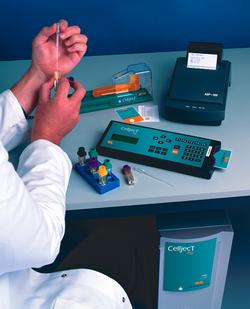 Equibio Ltd.'s CelljecT Pro system |
Each of these methods has advantages and disadvantages, often requiring researchers to compromise on one aspect of their experiment to maximize another. As a result, companies continue to improve existing technologies and to develop new ones that decrease the expense of transfection experiments, increase their efficiency, and enable transferring from one system or cell type to another. In this profile, LabConsumer reports on some of the new transfection and transduction kits available today.
The first methods developed to introduce DNA into mammalian cells relied on cellular endocytosis. A variety of molecules and compounds can be used to buffer the negatively charged phosphate backbone of the nucleic acid, including diethyl-aminoethyl (DEAE)- dextran for transient transfections1 and CaPO42 and a number of cationic liposomes3 for transient and stable transfections. These methods, particularly DEAE-dextran- and CaPO4-mediated, are relatively simple and inexpensive, making them popular for routine transfections. However, some cell types, especially primary cell cultures, resist these treatments. DEAE- dextran- and liposome-mediated protocols require a choice between serum-derived transfection inefficiencies and serum- negative cytotoxicity. In addition, CaPO4-mediated transfections can suffer from poor reproducibility due to variations in transfection-complex size and shape, while liposome-mediated protocols can vary widely in efficiency and effectiveness with different cell types.
To address these concerns, companies have developed a variety of new products. The FuGENE(tm) 6 Transfection Reagent from Roche Molecular Biochemicals Inc. of Indianapolis has received favorable reviews on Biowire.com for its ease of use and low cytotoxicity, which allows fewer medium changes after transfection. According to the company's literature, more than 250 cell lines have been successfully transfected with FuGENE(tm) 6. Also from Roche, the X-tremeGENE Q2 Transfection Reagent is specifically designed and optimized for transfection and high-level protein expression in HeLa, K562, and Jurkat cells.
Qbiogene Inc. of Carlsbad, Calif., offers a variety of options for gene delivery, including GeneSHUTTLE(tm)-20 for primary cell transfections, GeneSHUTTLE(tm)-40 for primary and cultured cells in the presence of serum, and In Vivo GeneSHUTTLE(tm), a DOTAP:cholesterol systemic gene delivery reagent. Qbiogene also offers DuoFect(tm), a nonliposomal, transferrin-based, receptor-mediated transfection reagent. Novagen, of Madison, Wis., recently introduced the GeneJuice(tm) Transfection Reagent, a polyamine reagent that exhibits low cytotoxicity, which can be used in the presence or absence of serum. Finally, Life Technologies of Rockland, Md., has the OLIGOFECTAMINE(tm) Reagent, which is optimized for the delivery of functional antisense oligonucleotides into a variety of cultured eukaryotic cells.
| Courtesy of Promega |
 Traditional transfection techniques |
It's Electric
Electroporation relies on high-voltage pulses that cause the cellular membrane to break down, producing transient pores through which DNA can enter. The main advantage to this technique is that it can be used effectively for stable and transient transfections of all cell types. Not surprisingly, however, this method also results in high cell mortality, necessitating greater quantities of DNA and cells than CaPO4- and liposome-mediated techniques. Additionally, this technique uses cells in solution or suspension, thus rendering in situ experiments impossible.
Equibio Ltd. of Kent, U.K. (now part of Hybaid Ltd. of Middlesex, U.K.), has developed the 'In situ' Adherent Cell Cuvette System to allow researchers to electroporate cells in the stationary phase. The system consists of the Adherent Cell Cuvette, specially designed to accept cells growing on encapsulated membranes (also included), and the Adherent Cuvette Chamber, which fits most commonly used electroporators. Cells are grown on a standard microporous membrane, which is then transferred directly to the cuvette from the growth medium. Directional transfection studies can be performed with this system since molecules can be added to either the upper or lower compartment of the Adherent Cuvette Chamber before electroporation.
Eppendorf AG of Hamburg, Germany, offers the Multiporator(r), an electroporation system that uses Soft Pulse(tm) Technology. This technology combines patented electronically controlled microsecond "soft" pulses with a hypo-osmotic buffer system. These modifications increase transfection rates in eukaryotic cells compared to conventional electroporation products that use pulses in the millisecond range and isoosmotic buffers.
Two companies have developed products that uniquely address some of the disadvantages associated with electroporation. BTX of San Diego, Calif., a division of Genetronics Inc., offers the Electro- FlowPorator(tm) system, which is capable of electroporating large volumes of mammalian cells, either in batch-processing or continuous flow modes. This system has been used by scientists at the National Institutes of Health to produce adenoviruses for gene therapy by electroporating several liters of mammalian cells at a time.
Tritech Research Inc. of Los Angeles offers The Cloning Gun(tm), a cordless, rechargeable hand-held instrument. Rather than pipettes or cuvettes, this instrument uses a disposable Pipectrode(tm) to draw up the mixture of DNA and cells with a thumbwheel-
operated pump. The Pipectrode's thin stainless steel electrodes and temperature stabilizers reduce cytotoxicity and improve transfection efficiency, as compared with aluminum cuvettes. After just a pull of the Cloning Gun's trigger, the transfected cells can be ejected into either a flask or a petri dish. This design is less cumbersome than traditional electroporators and allows researchers to electroporate on either the lab bench or in a sterile hood. Separate BactoZapper(tm) and MammoZapper(tm) versions are preset for high-efficiency transfection of bacterial and mammalian cell types.
Viral-mediated Transduction
Transduction, or viral-mediated transfer of DNA into cells, is another delivery option that offers the most efficient means of gene delivery to a wide variety of cells. For example, many recombinant viral vectors allow the expression of transgenes in slow-growing and postmitotic cells and provide an effective means for local delivery in vivo. However, transduction protocols pose a number of concerns for researchers. First, the preparation and use of viral vectors can be arduous and time- consuming. Moreover, although these viruses are rendered replication- defective before use, additional biosafety precautions need to be taken when working with these infectious particles in the laboratory. Although there are a number of viruses in use today, this article focuses on retroviruses, adenoviruses, and baculoviruses and highlights some user-friendly products that take advantage of these systems.
Retroviruses, which are single-stranded RNA viruses, can be used to stably transduce dividing cells without the worry of immunogenic viral proteins being expressed. CLONTECH Laboratories Inc. of Palo Alto, Calif., offers the Retro-X(tm) System, which includes the RetroPack(tm) PT67 cell line and three retroviral expression vectors, to produce infectious, replication-incompetent retrovirus for transduction of mammalian cells either in vitro or in vivo. La Jolla, Calif.-based Stratagene Inc. offers ViraPort(tm) retroviral cDNA expression libraries for the researcher interested in cloning genes by function. These premade cDNA libraries, offered as bacterial stocks, may be used with any Moloney murine leukemia virus (MMLV)-based packaging system, thus allowing researchers to transfect their packaging cell lines of choice.
Stratagene also offers a growing number of premade cDNA libraries as ViraPort Transduction-Ready VSV-G Retroviral Supernatants. These are ready for immediate use on a wide range of mammalian cells--including mouse, rat, and human--thus saving time and money by removing the packaging steps and the need to maintain the packaging cell lines. Finally, Stratagene offers a selection of Vpack Vectors that allows the user to package virions using almost any highly transfectable mammalian cell line. Once the genetically engineered viruses are made, the RetroNectin(tm) Reagent, from PanVera Corp. of Madison, Wis. (manufactured by Takara Shuzo), can be used to enhance retroviral-mediated gene transfer. RetroNectin is a recombinant, chimeric fragment of human fibronectin that is coated on the surface of the cell culture plate; it is available both as a lyophilized powder, and as pre-coated, 3.5-cm2 dishes.
Adenoviruses, which are non- enveloped, double-stranded DNA viruses, are often selected for mammalian cell transduction because they offer a number of advantages over retroviruses. For example, adenoviruses handle relatively large transgenes, are produced at high titer, and can efficiently infect a wide variety of both dividing and nondividing cells. The construction of recombinant adenoviral vectors, however, can be laborious. These vectors are traditionally generated in one of two ways. One method is to ligate the gene of interest directly into the adenoviral genome. This can be difficult, however, as the adenoviral sequence contains few unique restriction sites. The second method requires the researcher to first clone the sequence of interest into a shuttle vector before transferring the gene into the adenoviral genome via homologous recombination in vivo.
Because this second method is a relative improvement over the first, companies have focused their efforts on providing researchers with faster and easier methods to accomplish this task. Qbiogene's Adeno-Quest(tm) kit provides all of the necessary reagents to create recombinant adenoviruses by homologous recombination in 293 cells. The AdEasy(tm) Adenoviral Vector System, offered by Stratagene and Qbiogene, avoids the time-consuming process of isolating and identifying recombinant adenovirus via multiple plaque isolations by performing the homologous recombination between the adenoviral genomic plasmid and the shuttle vector in bacteria. Qbiogene's AdenoVator(tm) system, which offers increased protein production and co-expression of your gene of interest with a reporter such as GFP or LacZ, is fully compatible with the AdEasy system.
The AdMax(tm) system from Microbix of Toronto offers an alternative approach. This system eliminates the need for homologous recombination in troublesome bacterial strains by taking advantage of the Cre-loxP or FLP-frt recombinase systems. Recombination in cotransfected cells simultaneously inserts the gene of interest into the genomic plasmid while excising the recombinase gene, thus avoiding the necessity of linearizing the shuttle vector and the genomic plasmid.
 Tritech's Cloning Gun |
Unlike adenoviruses, baculoviruses are only able to replicate in cells derived from two lepidopteron (moth) families. Because infectious baculovirus virions are not produced in mammalian culture, working with baculoviruses often requires less extensive biosafety precautions. The generation of baculovirus vectors is a two-step process involving insertion of the gene of interest into a shuttle vector (a "bacmid") followed by transfection-induced homologous recombination with linearized viral DNA. Baculovirus solutions that employ this strategy include Novagen's pTriEx(tm) Baculovirus Expression System, Invitrogen's MaxBac(tm) 2.0 Kit, and CLONTECH's BacPAK(tm) Baculo-virus Expression System.
Life Technologies' Bac-to-Bac(r) system uses a different approach. Recombinant baculovirus DNA is generated by site-specific transposition in bacterial cells. The gene of interest is cloned into a plasmid vector between Tn7 transposon ends, and transformed into bacteria containing a bacmid with a Tn7 attachment site. Following antibiotic selection and screening, recombinant baculovirus DNA is isolated and transfected into insect cells. As a result, all of the viral particles from a transfection are recombinant and from a single transposition event. Each of these kits provides researchers with vectors, viral DNA, and insect host cells, thus representing a complete system for recombinant protein expression.
Deborah L. Stull (stull@fas.harvard.edu) is a freelance writer in Boston.
References
1. A. Vaheri, J. S. Pagano, "Infectious poliovirus RNA: a sensitive method of assay," Virology, 27: 434-6, 1965.
2. F. L. Graham, A. J. van der Eb, "A new technique for the assay of infectivity of human adenovirus 5 DNA," Virology, 52: 456-67, 1973.
3. P. L. Felgner et al., "Lipofection: a highly efficient lipid-mediated DNA-transfection procedure," Proc. Natl. Acad. Sci. USA, 84: 7413-7, 1987.
4. J. G. Lewis et al., "A serum-resistant cytofectin for cellular delivery of antisense oligodeoxynucleotides and plasmid DNA," Proc. Natl. Acad. Sci. USA, 93: 3176-81, 1996.