Microscopy Paraphernalia
Accessories and peripherals boost performance
By Jorge D. Cortese
 Suppliers of Microscopy Peripherals - Supplemental Table not in Print Edition
 Andover filters |
First, the number of Charge-Coupled Device (CCD) cameras for biological microscopy is staggering (the accompanying table shows typical properties of one-third of available models). The cameras are composed of a sensor (the CCD) and an analog-to-digital converter; the reading of light by individual sensor elements generates an image composed of a two-dimensional array of pixels (or "picture elements"). CCD cameras have various operational architectures. Interlaced cameras scan an image in two steps, usually odd and even horizontal lines, and then reconstruct it in a buffer; this method was developed to decrease monitor flickering. Interline-transfer cameras have extra storage readout sites that transfer images to a register, allowing interlaced pixel reading without repeated imaging. Other CCD cameras have progressive-area scan capabilities; they transfer the entire image without interlacing.
Another design issue in CCD cameras is the number of chips. Single-chip cameras are smaller and can generate color using specialized sensor areas that detect R (red), G (green), and B (blue) components, causing a loss of effective resolution. Multiple-chip designs (3CCD) are somewhat larger, using a beam-splitter and R-, G-, and B-chips ("taps") to detect each color component. Here, resolution is maintained. Any color seen by the human eye can be reconstructed using RGB-based imaging. Secondary to chip design, sensor size is a limiting factor in sensitivity and resolution.
CCD cameras also have a frame rate that can be much faster than that of analog video cameras (over 30 frames per second), and a digital output rate (usually in cycles/second or Hz), dependent on the analog-digital converter. The output current while the devices are in the dark is known as dark current; a high dark current can limit long-term integration. CCD cameras can be "cooled" to sub-zero temperatures, thus minimizing noise and thermal variations; cooling reduces dark currents.
Then there's the "pixilated" digital image itself.1,2 Gray level describes the brightness of each pixel and relates to the digital dynamic range (or bit "depth"). A bit may be either 1 (on) or 0 (off); thus, an 8-bit image can store 256 (28) shades of gray and a 12-bit image can store 4,096 (although they may look identical on a 256-color display). If the gray-level scale of the darkest areas is expanded, a 12-bit image will reveal greater detail than an 8-bit one; also, quantification will be more precise in 12-bit images. Bit depth is thus an additional image dimension, and it should be carefully considered when purchasing a camera. Color cameras with three 8-bit CCDs may describe their dynamic range as 24-bit, but the images are still only 8-bit. A color image has additional pixel intensity properties: hue, or the characteristic color seen (e.g., blue), and color saturation, the color strength or brightness.3
Bit depth is adversely affected by camera noise.4 The level of overall noise (in decibels, or dB) is usually expressed as a Signal/Noise (S/N) ratio: S/N (dB) = 20 * log10 (S/N). Thus, a S/N ratio of 100/1 is equivalent to 40 dB. Sometimes decibels are used to express another dynamic range as a ratio between the maximum and minimum detectable light intensities.
To increase sensitivity for low-light observation in specialized ion imaging experiments, some cameras are hooked up to an intensifier, an expensive and delicate electron-cascading device that generates a higher secondary signal. CCDs that are not intensified may increase sensitivity using "binning" (or "super-pixeling"). This technique increases sensitivity and frame rate by grouping pixel intensities. If the creation of these super-pixels (e.g., a 2 x 2 area) is done at the hardware level, the signal will be four times higher, but the noise will remain the same, thus quadrupling the S/N ratio. If a memory buffer is used to keep the pixel values, the noise will be additive with the square root of pixel number (i.e., N will double for four binned pixels), and the S/N ratio will double.
After the needs of a particular lab are defined, a number of factors should be considered, including hardware compatibility, connectivity, and software requirements. Most camera specifications are usually available on the Web. A demonstration of two or three candidates should be arranged to make a final choice.
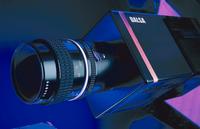 The Dalsa 1M30 CCD camera |
Filter World
Almost every experiment that goes from the board to the bench requires a new filter. Understanding their general properties, as well as filter-related jargon, will help you choose the right one. The ability of light to pass through the filter is known as Transmittance (T); it is usually expressed as a percentage of energy transmitted and relates to Optical Density (OD) or absorbance as: OD = log10 (1/T). The bandwidth of a filter (bandpass) is defined by a wavelength span between the two half-maximum points of the T-spectrum; this wavelength interval is also known as Full-Width at Half-Maximum (FWHM). Out-of-Band rejection (or blocking) is a measure of the transmission of light outside the bandpass (an undesirable property). Other properties such as resistance to temperature or environmental humidity might be useful for filter evaluation. As the filter collection grows, a familiarity or "sense" of specific filter needs develops. This intuition also can be developed by talking to application specialists at different manufacturers and by using different filters.
Chroma Technology Corp. of Brattleboro, Vt., offers a number of filter sets designed for specific combinations of fluorescence probes, and that avoid the "bleed-through" of unspecific emission (e.g., the Sedat Quad filter set). Omega Optical Inc. of Brattleboro, Vt., also provides numerous filter sets for a variety of single- and multiple-labeling fluorescence microscopy applications, such as ratio imaging, Pinkel, and fluorescence resonance energy transfer (FRET). Additional single-dye DsRed filter sets are designed to work with the new red fluorescence protein mutant (RFP). Omega's new line of ALPHA VIVID(tm) filter sets utilizes proprietary ALPHA technology to produce steep bandpass cut-on and cut-off slopes, thus generating a deeper blocking between exciter and emitter, and higher S/N ratios. The Curvomatic spectral database tool on Omega's Web site allows visualization of the spectral performance of each filter combination. Glen Spectra Ltd., of Middlesex, U.K., distributes Omega's new SPECTRAPLUS triple bandpass-interference filter coating, which enhances color saturation and gives accurate hue, leading to increased S/N ratios.
Other companies in the filter business support microscopists by creating "designer" filters. Barr Associates Inc. of Westford, Mass., designs and manufactures precision optical filters. Its primary business is to provide customized filter solutions by coating thin films with multiple deposition technologies. Lambda Research Optics Inc. of Cerritos, Calif., can custom-design filters and other optical elements for laser-based applications. Providers such as Schott Glass Technologies Inc. of Duryea, Pa., directly supply original equipment manufacturers.
Neither Shaken nor Stirred
Although microscopes are occasionally spotted on bare tables and even floors, optical machines require a vibration-free environment. Fortunately, products are available to help cut unwanted vibrations. Kinetic Systems Inc. of Boston has a wide line of vibration isolation systems, plus optical tables for massive, multi-instrument setups. Benchtop models such as the 2200 Series BenchMate offer vibration-free platforms for microscopes, both with passive air (using a hand-pump) or with sophisticated self-leveling and active air control for heavier regular use.
Kinetic Systems' LabMate series is comprised of floor models: the 9100 series (LabMate I Workstation) has vertical and horizontal vibration isolation, different tabletop materials, and high-performance active-air suspension; the 9211 series (LabMate II Workstation) is similar to the 9100 model but with a smaller footprint; the 9600 series (LabMate III Workstation) complies with Class 1 or Class 10 cleanroom environments. Newport Corp. of Irvine, Calif., also offers vibration-free systems for all tastes. The SlimLine(tm) is a table-style station for space-restricted areas: the SLR series uses RS300(tm) damping technology, and--along with the low-cost SLT series--laminar-flow Stabilizer(tm) isolation technology. For light loads (up to 1,000 lbs.) and limited budgets, the LW series has two isolation options and a small 30-inch footprint.
A third provider is Technical Manufacturing Corp. (TMC) of Peabody, Mass. TMC's TableTop 64 platform series (up to 250 lbs.) contains isolators in a cradle for added stability, and is available with several top surfaces (granite, stainless steel laminate, and a CleanTop(tm) steel honeycomb). The TableTop 66 plate series is a lightweight (up to 75 lbs.), compact model able to isolate from mid- and high-frequency vibrations. The 63-500 high-performance LabTable series (up to 1,200 lbs.), is a floor model, combining several isolation technologies to cancel horizontal and vertical vibrations.
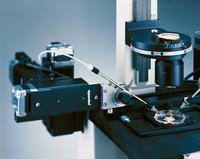 Eppendorf's TransferMan NK |
Moving Things Around
The repetitive nature of many microscopic experiments can wear out the poor knob-handling fingers of tired scientists. Micropositioning devices convert this painful aspect of microscopy into something akin to a video game with buttons and joysticks.
Burleigh Instruments Inc., of Fishers, N.Y., offers an extensive line of micropositioning devices for the life sciences. These include the LSS-1000 Inchworm(r) microdrive system, which positions electrodes for electrophysiology, and the GIBRALTAR Platform and X-Y stage system, which allows very precise micrometric movements of the microscope's objective between fields-of-view. GIBRALTAR has four rigid columns that can be adjusted for optimum height; this allows micromanipulators or chambers to be installed around the microscope.
Prior Scientific of Rockland, Mass., has the OptiScan(tm), a new stage for routine applications that works with many imaging programs and fits most upright microscopes; it can be setup as an XY, XYZ, or Z-only stage system. Prior Scientific's ProScan(tm) stage has a modular design that fits most upright and inverted microscopes and possesses a sophisticated controller capable of managing the stage, a focusing motor, up to two filter wheels, and three shutters. Other options include a fourth axis for applications that require theta rotation, autofocus capability and through-the-lens input/output. The Filter Wheel system, compatible with both stages, delivers smooth operation, changing filters in as little as 55 milliseconds.
To move plates around, Stoelting Co. of Wood Dale, Ill., offers a series of large DC motorized stages that can be fitted to most inverted microscopes and can track and display the current stage position, or move to specific locations with 16 micron-resolution. These stages can hold four slides, two Terasaki plates, or one Petri dish; their controller can be operated by computer joystick or with a 16-key programmable keypad. Stoelting also offers the Quixell(tm), a device that combines the motorized stage with a robotic mechanism for selection and transfer of cells. Clemex Technologies of Longueuil, Quebec, has developed a motorized stage kit that can be adapted to many microscopes and allows users to analyze up to 10,000 fields. Used in conjunction with Clemex's image analysis software, Clemex Vision, the stage can accurately move to individual objects of interest after an analysis has been completed. The Z-automation is able to compensate for problems of depth of field, slicing the image at multiple Z-levels to piece all focused regions into one completely focused composite image.
Micromanipulation and microinjection are typical expansions of today's microscope setup. Eppendorf Scientific Inc. of Westbury, N.Y., offers many options. Eppendorf's 5178 TransferMan(r) NK micromanipulator is useful for techniques involving suspended cells. It is controlled by proportional kinetics (NK), a protocol that ensures accuracy and reproducibility for demanding cell transfer or micromanipulation applications, by directly transmitting the joystick's movements to the microinjector's capillary. Eppendorf also offers the universal-fitting Micromanipulator 5171, the InjectMan(r) 5179 microinjector (adherent cells), and the FemtoJet(tm) 5247 injector (adherent and suspended cells). Narishige Co. Ltd., of East Meadow, N.Y., also has an array of micromanipulators and microinjectors, including single-axis (MMO-220B) and three-axis (MMO-202 N/ND) micromanipulators. Burleigh Instruments manufactures micromanipulators and microinjectors with solid-state technology (piezoelectric) that achieves precise and fast positioning without lags, drift, vibration, or overshoot.
Specialized microinjection instruments are also available. Drummond Scientific Co. of Broomall, Pa., has developed the NANOJECT II(tm) for high-precision, vibration-free injection of oocytes (volumes between 2.3 and 69 nl), using a lower injection volume and a new high-torque, smoother motor. MicroData Instrument of South Plainfield, N.J., offers programmable microinjectors, including two-channel (PM-1000 and PM-2000), four-channel (PM-2000B) and eight-channel (PM-8000) models. Other specialized microinjectors are produced by Narishige (IM-5A-2 for large volumes), and Tritech Research Inc. of Los Angeles (microINJECTOR(tm), with fast pulse length and timing controls).
Keeping Cells Happy
Any cell biologist interested in extended live cell experiments should consider adding a cell chamber with controlled atmosphere and temperature. Bioptechs, Inc. of Butler, Pa., offers a closed-chambered system (FCS2 System), an open culture dish system (Delta T system), and an Objective Heater System for temperature-controlled micro-observation compatible with all microscopy modes. The FCS2 system is a parallel plate chamber that combines high-flow perfusion and precise temperature control with sharp Koehler illumination. Temperature control is transferred through the Indium-Tin oxide (ITO)-coated microaqueduct slide; perfusion is accomplished with a set of "T"-groove perfusion ports.
To avoid heat loss through the objective, an objective heater--containing a sensor and heating band--maintains the objective at the chamber's temperature. For cooling, a closed-system cooled chamber is available, including an objective collar that removes heat from the objective and slide. If an open setting is needed (e.g., for microinjection), the Delta T System provides thermal regulation through an ITO-coated coverslip glass-bottomed dish. Cell chambers based on a securing ring design are also available from ALA Scientific Instruments Inc., of Westbury, N.Y. Chambers with a round-center design (MS-502 for 24/25-mm coverglass; MS-508 for 18-mm coverglass) and an oval-center design (MS-518; 24/25-mm coverglass) are available. Options include built-in perfusion ports, a thermal foil add-on for temperature control, low-wall option for electrode access, and a coverglass alignment slot on the securing rings.
Illuminations
A light microscope is useless without a light source. EFOS Inc. of Missisauga, Ontario, has developed a novel fluorescence illuminator, the X-Cite(tm), which delivers a uniform field-of-view and maximum energy spectrum from a 50 W metal-halide lamp, outperforming 100 W mercury-arc lamps. The X-Cite features a 2,000-hour lamp, a foot pedal control that leaves hands free; easy snap-out/snap-in replacement; post-shutdown temperature monitoring (to ensure a "safe-to-restart" state), and about 10 times the lifespan of conventional lamps. Lamps are prealigned, and an Intelli-Lamp(tm) system maintains consistent output intensity over time and between lamps. Alternatively, Photon Technology International Inc. (PTI) of Lawrenceville, N.J., has developed the NovaLight(tm), an illuminator with a special housing design that delivers up to seven times the output of conventional arc lamp housings. An integrated, changeable dichroic "cold" mirror eliminates the damaging IR portion of the lamp's spectrum. NovaLight can be coupled with microscopes directly (NovaLite DM mount) or with a light guide (NovaLite LG).
Other illuminators are the MHC-50 from PerkinElmer Optoelectronics of Santa Clara, Calif., and Prior Scientific's 150-CL illuminator. Finally, it is useful to find the lamps themselves. Bulbtronics(r) of Farmingdale, N.Y., sells lamps for most microscopes, also providing bulbs, sockets, transformers and batteries.
Other Add-ons
A standard microscope can be modified in a number of different ways. Some instruments help to automate a microscope's components, and Applied Scientific Instrumentation of Eugene, Ore., offers a variety of automation peripherals, including the Polychrome II, a high-speed monochromator developed by TILL Photonics of Martinsreid, Germany, that can jump to any wavelength between 250 and 680 nm in less than 3 milliseconds. Other optical enhancements target the standard lightpath. The PERCEPTRA(tm) from Bunton Instrument Co. of Ijamsville, Md., is a multiple, oblique illumination system that retrofits inverted microscopes, including those with infinity-corrected optics; it replaces the light source and provides visual images that appear three-dimensional. The VariSpec(tm) tunable filters from CRI Inc., of Woburn, Mass., are liquid crystal (LC) light management filters that allow electronically controlled, vibration-free selection of any visible or near-IR wavelength. Using this technology, CRI created the Micro*Color(tm), an LC filter that is RGB color switched to allow for image acquisition in under one second. By switching between the RGB colors, a color image is generated from monochrome cameras, maintaining the original resolution.
Documentation of specimen images requires digital cameras specifically designed for simple use. Eastman Kodak Co. of Rochester, N.Y., offers the Microscopy Documentation System (MDS290), with a 2.1 Megapixel (Mpix) digital camera (24-bit color; 3X optical zoom) and USB interface. The SPOT RT (Real-Time) microscopy camera (1.92 Mpix, 24/36-bit color, 8/12-bit monochrome) from Diagnostic Instruments Inc. of Sterling Heights, Mich., combines color and black-and-white quantitative modes in one camera using a slider. Finally, the AxioCam digital camera (color or monochrome models), from Carl Zeiss Inc. of Thornwood, N.Y., has programmable resolutions and sensor technology.
If one really wants to change things around but enforces the "don't-try-this-at-home" motto, Rolyn Optics Co. of Covina, Calif., has developed building blocks that allow expanding or modifying parts of a microscope, thus adding different lightpaths or oculars, just to name a few possibilities.
Jorge D. Cortese (jorge_cortese@mindspring.com) is a freelance writer in Durham, N.C.
References
1. R.H. Webb, C.K. Dorey, "The pixelated image," in Handbook of Biological Confocal Microscopy, J.B. Pawley, Editor, New York, Plenum Press, 1989, pp. 55-67.
2. J.C. Russ, The Image Processing Handbook, 3rd ed., Boca Raton, Fla., CRC Press Inc., 1999.
3. S. Inouğ, Video Microscopy, 2nd ed., New York, Plenum Press, 1997.
4. K.R. Spring, "Scientific imaging with digital cameras," BioTechniques, 29: 70-76, July 2000.
| The Scientist 14[24]:26, Dec. 11, 2000 |