P-1000


Multi-use Glass Micropipette Puller

P-1000:  $3,135.14 - Usually ships in 1-5 days
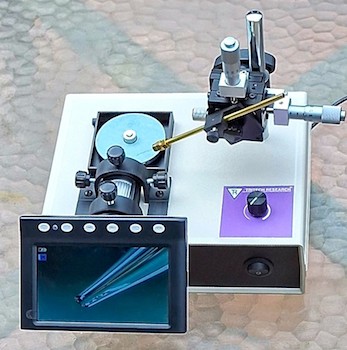
Tritech's P-1000 needle puller provides a lower-cost alternative to units from Sutter, WPI, RWD, Campden, and the Narishige PN-31, PE-22, and PC-100. As a heavy user and reseller of micropipette pullers, we realized that horizontal pullers are unnecessarily complicated, expensive, and less robust than vertical pullers. Even Narishige's venerable pullers presented a pricey overkill for preparing microinjection needles, microelectrodes used in patch clamp studies (intracellular recording), and microperfusion. We decided to produce the P-1000 in response.

The P-1000 incorporates several key features that make it an ideal choice for producing microinjection needles and pipettes for patch clamp experiments:

  • The built-in power source is specially designed to deliver a stable, uniform amount of power to the heating coil each time and make uniform glass needles and micro-capillary pipettes. Heater levels can be varied in 1000 steps (0.1% precision) and are shown on a highly-visible digital display.

  • Finely adjustable pulling force is provided by the earth's gravity via 50 small incremental weights — you can't get much more stable or reliable than that! There are no electromagnetic coils to burn out. The force can be varied by adding or removing the included weight discs.

  • Settings for normal heating, stand-by heating, and timed pre-heating allow for a wide variety of needle tip geometries that traditionally required complicated mechanics in competing pullers.

  • A variety of optional heating coils and holders allow for pulling 1.0-1.5mm, 2mm, 3mm, 4mm, and even 5mm multi-bore glass tubes.

  • Full heating range for borosilicate and aluminosilicate glass. Optional heaters for fused silica (quartz glass) pipettes.

  • Also included are spare heater coils(PC-10H).


We now offer the P-1000 along side Narishige's dual-stage PC-100 to replace the old PC-10, PP-830, PP-83, and even older model PB-7. These models serve as lower-cost and more robust alternatives to Sutter's P-30. We use the P-1000 here at Tritech Research to pull our pre-pulled microcapillary needles (see MINJ-PP) that we sell for C. elegans, Drosophila, Xenopus, Zebrafish, and transgenic mouse work.

Here is a video that shows how the P-1000 works:


(Click "YouTube" for captions and larger view)


Here is a Narishige video that shows how pulling force and heat level parameters affect needle tip length and taper. The P-1000 works the same way. Note: This video also demonstrates a two-stage automated pull. If this is critical for your work, you can order the PC-100.


Specifications
Accessories included Spare PC-10H Heaters,
Power Cord
Power source 100VAC-240VAC
Power consumption < 100W
Heater levels 1000 increments
Pulling Weights
Set of 50 weights
Dimensions/Weight W150 x D290 x H290mm, 4.3kg


Consumables
Model Product Description
PC-10H Heater Kanthal wire
Model Product Description
GD-1 Glass Capillary Tubes 1.0 mm O.D. w/ internal filament

FAQ's

Q: Why is the P-1000 considerably less expensive than other needle pullers?
A: Tritech Research took a first-principles deep dive into what is important to pull a variety of different types of glass tubing into a variety of shapes. We found that it's not as complicated as traditional units made it. We applied the temperature control circuitry already developed for our incubators to robust, simplified mechanics to create the P-1000, and now you can have it, too!

Q: After recently replacing the heater coil, my pipettes have tips that are not coaxial. What could be the issue?
A: If the heating coil is not positioned so that the glass goes through its center, the glass will heat and melt asymmetrically and produce an asymmetric tip.

Q: How can I set the parameters of the P-1000 to achieve a specific type of needle resistance or tip shape?
A: There are many variables to get a particular size needle opening equivalent to a particular resistance and also effecting tip geometry. These include not only the settings of the puller, but also the type of glass used (composition and diameter), the exact geometry of the heating element, its condition, etc. One suggestion is to contact a lab that is doing similar experiments and try to replicate their protocol when preparing your pipettes.

Generally speaking, a higher heater setting will give a longer thinner tip, and a lower setting will give a shorter, more stubby tip that goes from the full size to a point over a shorter distance. Using all of the weights makes the tip get fine and be sharp quickly, and using less weights makes the tip longer and the taper more gradual.

The tip may come out of the puller with the right size opening, or tips may come out completely sealed, and you will have to perform a secondary operation to open the end of the pipette to the size desired. For example, you can use the acid etching protocol described in the FAQ section at the bottom of this page.

Q: Our P-1000 isn't working right and seems to be overheating. What are some troubleshooting tips?
A: The first thing we recommend is checking the heating element itself. Make sure that it is not bent or touching back on itself between coils. Also make sure that it is still perfectly centered around the pipette, and not nicked or thinned. Be certain that it is making secure contact and not loose in any way on either side by tightening the screws that hold it in place. Call us for live troubleshooting help.

Q: How often does one need to replace the heating coil on the P-1000? How do we do it?
A: If the P-1000 is used carefully and at moderate heat settings, a heating coil can last for many years (almost indefinitely) and pull tens of thousands of needles. However, if it gets more than orange hot or gets banged into, bent, etc., then it can degrade or heat unevenly and fail quickly.

Fortunately, it's quite easy to change: First make sure the unit is unplugged / off, because the heater might be pre-heated even between pulls, depending on your OffHeat setting, even if it's not visibly hot. The copper clamps hold the heater on each side. You loosen them to remove the old heater (but note the orientation so you can replicate it), and insert the new heater. The tedious part is that, when you install the new coil, you have to carefully position it so that the capillary tube will go right through its center. This is done best by having a piece of glass in the unit before the final tightening of the clamps. It is also permissible to bend the heater slightly, using fine forceps to aid in centering.

Q: Can the P-1000 produce sharp electrodes needed for patch clamp recording purposes with a resistance in the 50 MegaOhm range?
A:Yes, the P-1000 is great for pulling very sharp pipettes with sub-micron openings.

† These are our list prices. If you are paying with an Institutional Purchase Order or by check, you qualify for a 7.5% discount. Click here to change your payment method and see the lower prices.